| About the School |
| Course Structure |
| Academic Curriculum |
| PME Curriculum |
|
| |
|
|
BASIC ENGINEERING SCHOOL: THE HUB OF TRAINING IN NNIT
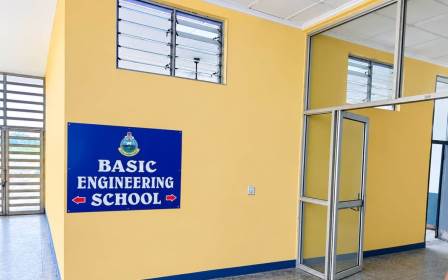
The Basic Engineering School (BES) is one of the eight schools in the Nigerian Naval Engineering College (NNIT), Sapele. It is the first point of call for most under-training officers and ratings. The BES is likened to a nursery school within NNEC, where most training activities begin before advancing to other major schools.
It is saddled with the responsibility of training Nigerian Navy (NN) personnel for the maintenance of equipment onboard various NN platforms. As one of the key priorities of the Chief of Naval Staff (CNS) is to maintain zero tolerance for anti-bunkering and anti-piracy activities, more platforms are being acquired by the NN. There is, therefore, a growing need for intensive training of personnel for the manning and maintenance of equipment and armament onboard these acquired platforms.
Historical Background
Before 1986, the British International Military Services (IMS) were responsible for the training of NN mechanicians in Port Harcourt, Rivers State, while artificers were trained in Collingwood, Britain. The trained mechanicians and artificers were skilled NN personnel responsible for the manning and maintenance of NN platforms.
In 1986, Messrs Dornier of Germany took over from the IMS for their training. Subsequently, the Nigerian Navy Technical Training Centre (NNTTC), Sapele, was established. The training of mechanicians stopped, and only artificers and mechanics were trained by Messrs Dornier. The school was established specifically to cater for the mechanics. Technical ratings who do not meet the requirements for the artificer course are drafted to BES for basic engineering training and subsequently for the Leading Mechanic Course (LMC).
Conduct of Training in BES
The training in BES is divided into two phases: the academic phase and the professional phase.
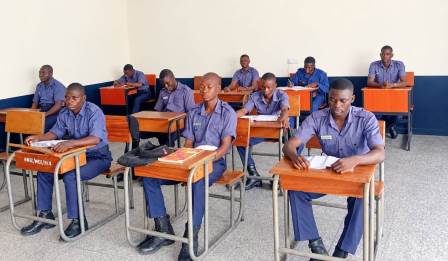
During the academic phase, Under Training Personnel (UTPs) are taught basic engineering principles and general knowledge. It is worthy to note that the academic phase is very important, as it sharpens the minds of the UTPs and serves as a work-up exercise.
The following subjects form part of the academic phase and are handled by seasoned and qualified instructors:
• Basic Mathematics
• Engineering Science
• Engineering Drawing
• Use of English
• Military History
• Maritime Domain Awareness
• French
On completion of the academic phase, the 2nd Rate/3rd Rate firemen and the POME/POWE qualifying courses advance to their professional courses in their various schools. Meanwhile, LMC and BMC continue their professional phase of training in BES.
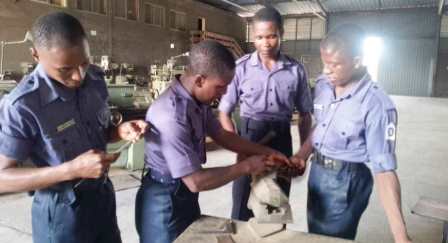
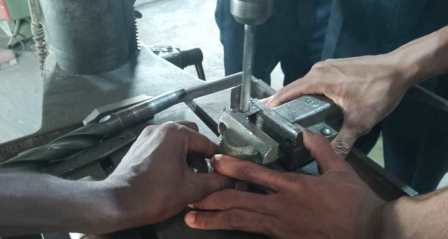
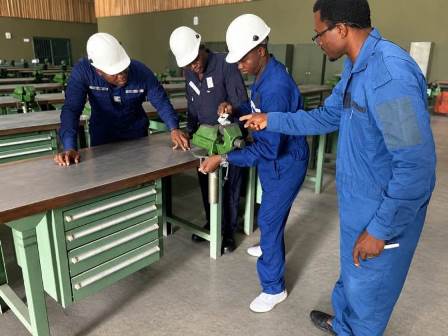
Despite paucity of funds, the Commandant approved funds for the purchase of work pieces for each of the UTRs to carry out welding, fabrication, and turning using lathe machines, among other tasks. Arc welding, cutting, joining of two work pieces, and fabrication are carried out in the workshop by LMC and BMC UTRs.
ACHIEVEMENTS
The Basic Engineering School (BES) has achieved a great deal over the years. As the hub of NNIT, it has trained numerous Nigerian Navy (NN) personnel who have gone on to effectively man and maintain various NN platforms in the field.
Despite the paucity of funds, the Commandant released funds for the purchase of materials needed for the training of both BMC and LMC personnel. The last set of BMC and LMC trainees were arguably the best trained during their course, and this has already begun to manifest onboard NN platforms, particularly in the area of main engine and generator watchkeeping, for which personnel in their category are trained.
Training of NN Personnel on Main Engine and Generator Watchkeeping
With over eight operational generators now available in the college, courtesy of the Commandant, the present set of BMC and LMC trainees have been earmarked to commence generator watchkeeping as part of their training. This move will make them better generator watchkeepers, especially when they go onboard after graduation, and will add significantly to their wealth of knowledge. In this way, one of the Chief of Naval Staff's key objectives—producing professionally sound and efficient manpower for the NN—will be achieved.
Conduct of Professional Training for LMC and BMC
Over the years, BES has trained many NN personnel professionally, especially in the areas of welding, fabrication, and the use of lathe machines for various purposes. The trained NN personnel can now compete favourably with their civilian counterparts in the aforementioned fields.
Training of NN Personnel in Basic Engineering During the Academic Phase
The school has trained numerous personnel during the academic phase of their training over the years. The courses covered during the academic phase include the OAC, POME/POWE course, 2nd Rate/3rd Rate Firemen courses, as well as LMC and BMC. It is worthy to note that some personnel who took part in French classes during their academic phase at BES have, upon graduation, taken additional intensive courses in French and are now proficient in the language.
|